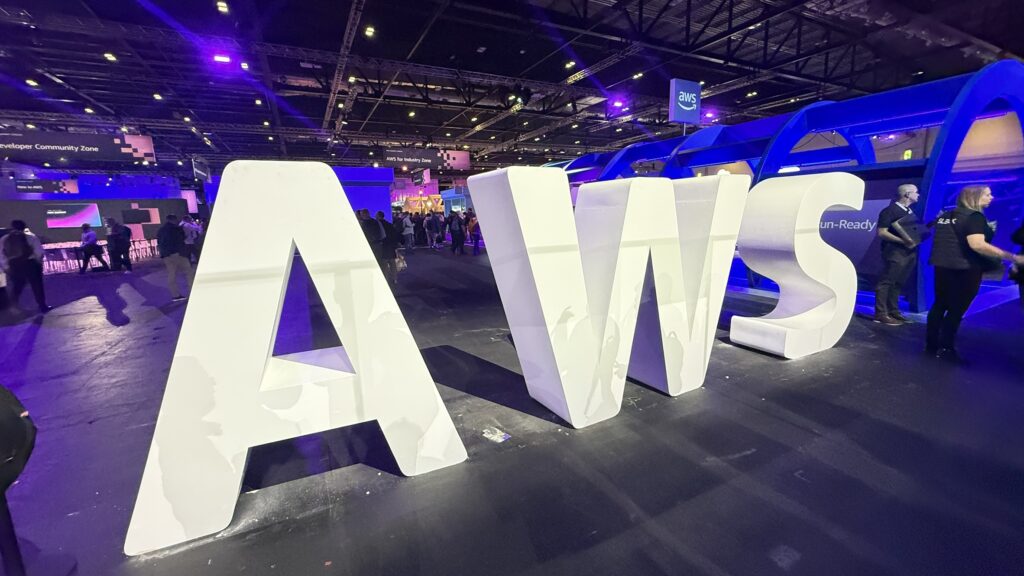
On April 22, 2026, over 20,000 people descended on London’s ExCeL to see firsthand where cloud and artificial intelligence are heading. I was one of them. As an AWS Partner and AWS Community Builder, I don’t go to these events for the slides. I go for context – the conversations that help me advise clients better and build stronger infrastructure. This year’s Summit delivered more of that context than any before it.
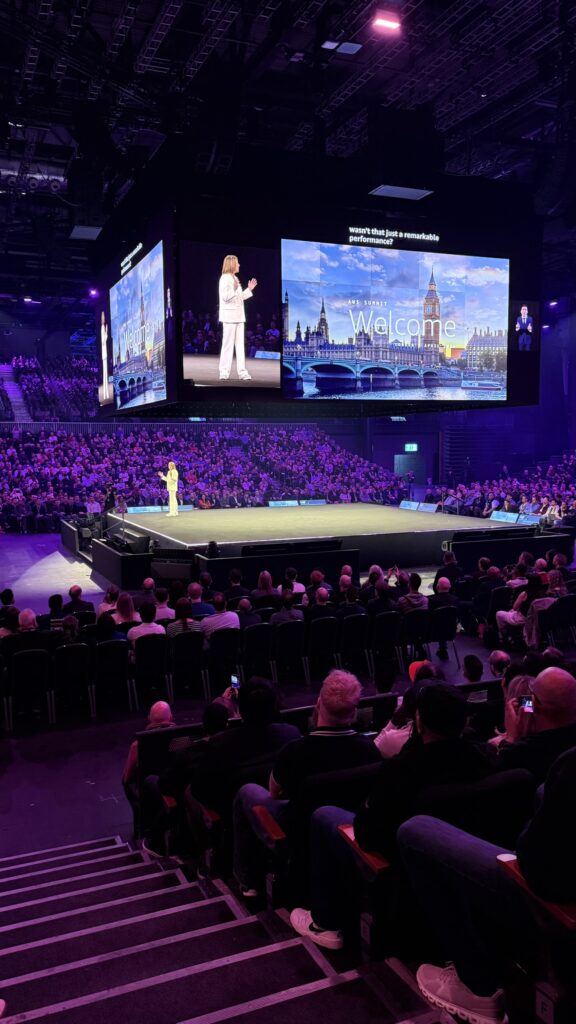
The conference’s overarching theme could be summed up in a single sentence: AI agents have moved from experiment to production tool. But beneath that headline lay much more – from fundamental shifts in how software is written, through the invisible engineering that powers the entire AWS platform, to concrete case studies of companies already operating in an entirely different mode than a year ago.
Opening Keynote – three pillars and one striking demo
The conference opened with Alison Kaye, VP and Managing Director of AWS UK & Ireland, putting forward a thesis that echoed throughout the day: what recently seemed like magic is now method. Kaye laid out three pillars underpinning this transformation – modern cloud infrastructure, artificial intelligence, and the skills of people who know how to combine these technologies into working solutions.
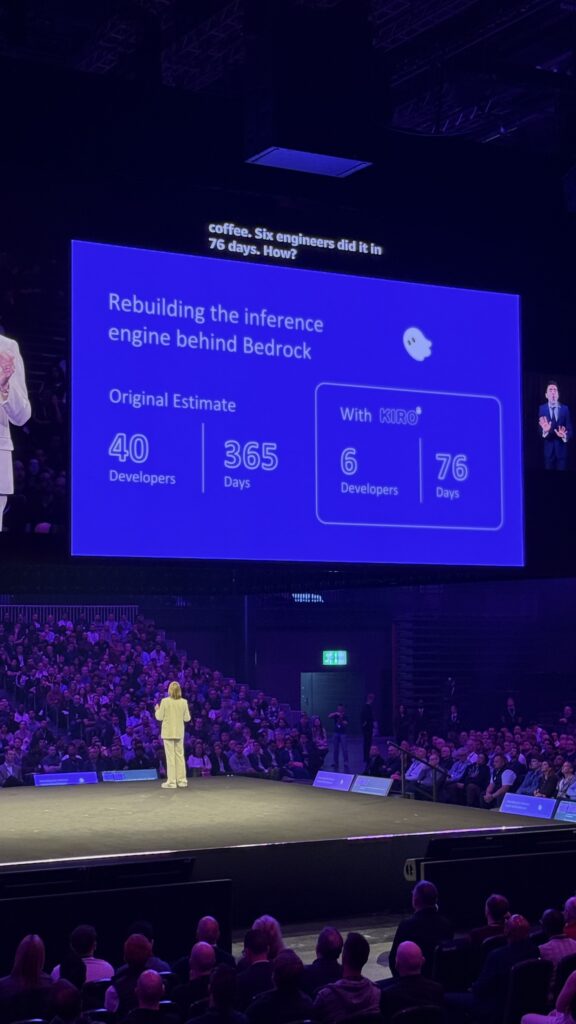
The most telling example came from within AWS itself. The team that rebuilt the Amazon Bedrock inference engine from scratch consisted of just six engineers. They did it in 76 days. Two years ago, a project like that would have required forty people and a full year. The difference was that the engineers worked side by side with AI agents that wrote code, tested it, found bugs, and deployed changes – including while the humans slept. This is not a vision of the future. It has already happened.
Kaye also shared data that should interest anyone planning a technology strategy in Europe. 64% of UK organisations have now adopted AI – up from 52% just a year earlier. That translates to one UK business adopting AI every 40 seconds. At the same time, only one in four of those adopters is using AI at advanced levels. The rest have stalled at productivity tools, basic automation, and experimentation. According to AWS research, moving from basic to advanced AI adoption could unlock £35 billion in productivity gains across the UK by 2030.
As someone who helps companies across Central Europe implement AI on AWS every day, I see the same pattern – organisations know they should be using AI, but they don’t know how to get from prototype to production. That was precisely what this Summit was about.
Kiro – an IDE that changes how software gets built
One of the keynote’s defining moments was the presentation by Francesco Vasquez, VP of Professional Services and Agentic AI, who officially introduced Kiro – a new development environment from AWS. Kiro is not another editor with code autocomplete. It is a tool that enforces engineering discipline – before writing a single line of code, it generates full specifications, user stories with acceptance criteria, technical design documents with architecture diagrams, and test plans.
Ryan Cormack, principal engineer at Motorway – a UK-based used car marketplace – took the stage next. His presentation was one of the strongest live case studies I have seen at an AWS conference. Motorway faced the classic scaling startup problem: engineering teams were growing, systems were multiplying, and the pace of delivering new features was starting to drop. AI tools helped write code faster, but every team was doing it their own way, without consistent standards.
Kiro solved this not by speeding up code writing, but by imposing structure. Every new feature at Motorway now starts with a specification – understanding what we are building and why, before anyone touches a keyboard. Steering files teach Kiro how Motorway builds its APIs, what the infrastructure looks like, and what the internal standards are. The result: Kiro generates over a million lines of code per month, teams have quadrupled their output, and 80% of engineers reach for the tool voluntarily, with no top-down mandate.
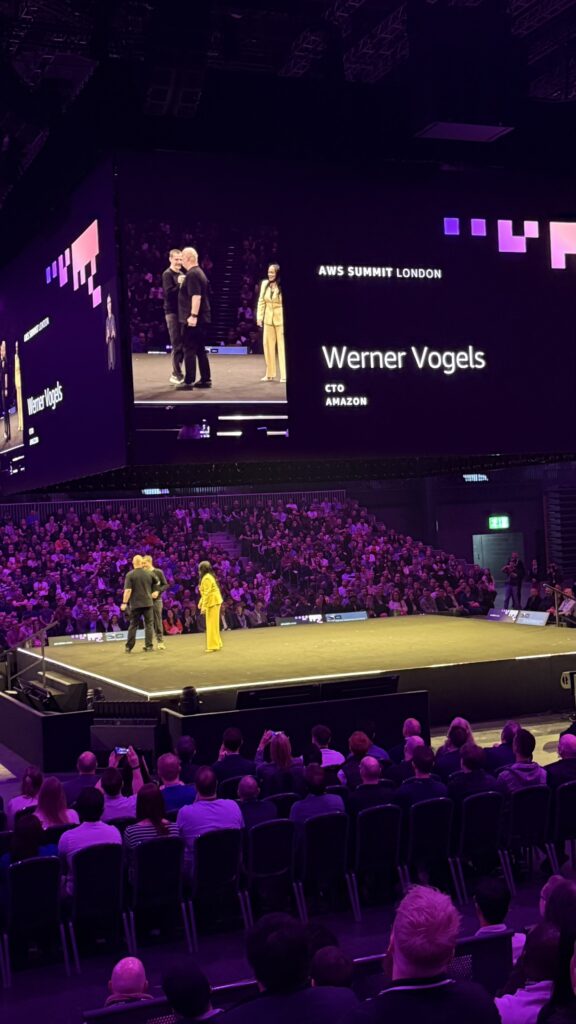
The moment Werner Vogels walked on stage to personally hand Cormack a „Renaissance Developer” t-shirt – a callback to his re:Invent 2025 keynote – was one of those human touches that give AWS conferences a character entirely different from typical tech events.
Frontier Agents – agents that work for hours
Vasquez also introduced the concept of Frontier Agents – a new class of AI agents that are autonomous, massively scalable, and capable of working for hours or even days. This is a fundamental shift from previous tools that operated within a single session.
The Kiro Autonomous Agent can work in the background, independently of the developer. Imagine upgrading a critical library used across dozens of microservices – the agent moves through repositories, updates code following design patterns, runs full test suites, and delivers merge-ready pull requests for review. All of this happens while the programmer focuses on something else entirely.
On top of that, two more agents were announced: the AWS Security Agent, which proactively scans design documents and code for vulnerabilities, and the AWS DevOps Agent, which independently diagnoses production incidents. The DevOps Agent demo was particularly compelling – the agent detected elevated authentication error rates in a Lambda function, used its built-in DynaTrace integration for additional context, identified the root cause as a mistake in a CDK deployment, and prepared a ready-to-review fix. By the time the on-call engineer logged in, the agent already had the solution.
As someone who has managed production AWS environments for years and leads an AWS User Group, I see enormous potential here. The DevOps Agent addresses exactly the problem I know from daily work – not a lack of technical knowledge, but the time spent manually correlating data across services during incidents.
AWS Transform Custom – no more excuses on legacy modernisation
Another significant announcement was AWS Transform Custom. AWS Transform had already been helping modernise VMware, mainframe, and Windows platforms, saving over a million hours of manual effort and transforming over a billion lines of mainframe code. Now, Custom lets you create your own transformation agents for any code, API, runtime, or framework specific to your organisation.
The ADP case study was striking. Their tax compliance system processed 77 million employee statements and $1.6 trillion in deposits across 8,000 jurisdictions. Business rules were hard-coded into the legacy codebase, making rapid regulatory changes nearly impossible. Using AWS custom transformation agents, ADP cut rule extraction time by 80% and reduced manual effort by over 90%.
For companies in Central Europe that I work with, this is a signal that legacy modernisation is no longer a multi-year project by default. The tools are ready – the question is who will use them first.
Octopus Energy – how technology transforms an entire industry
Greg Jackson, CEO of Octopus Energy, delivered one of the most inspiring presentations of the day. Octopus built its Kraken platform on AWS from scratch as a monolithic stack, deliberately prioritising maximum agility over the traditional enterprise approach. The results speak for themselves: the company processes 10 trillion rows of data per year (300,000 per second – ten times more than Visa globally), generates 430 forecasts daily, and manages 3 gigawatts of decentralised energy resources from electric vehicles alone.
Jackson made an astute observation: in a world where economic uncertainty is five times higher than it was twenty years ago, traditional multi-year IT projects are like building oil tankers that cannot turn when conditions change. Octopus chose a different path – continuous iteration, where every innovation becomes the launchpad for the next. Products like Agile Octopus, eliminating energy bills in new homes, or free electric vehicle charging – none of them could have emerged from a traditional enterprise software specification process.
Werner Vogels – 20 years of invisible engineering
Werner Vogels’ closing keynote, delivered by Amazon’s CTO, was entirely different from the rest of the conference. Instead of product announcements, Vogels took the audience on a journey through 20 years of engineering that happens beneath the surface of AWS – invisible to customers, but fundamental to everything that runs on the platform.
Vogels began with the history of Amazon.com – from the monolith of the 1990s, through data-driven decomposition (which turned out to be a mistake), to microservices, and finally the shared infrastructure that became the seed of AWS. Every stage of this evolution stemmed from the same approach: when the number of new features started to decline, engineers looked for an architectural solution rather than accepting limitations.
The three examples of invisible engineering that Vogels presented were fascinating from an architect’s perspective.
The first was Nitro – the platform that revolutionised virtualisation at AWS. The traditional approach generated up to 50% performance overhead. AWS engineers solved this by offloading networking, storage, and security onto dedicated cards on the PCI bus, eliminating Dom 0 (a full Linux kernel that represented a massive attack surface), and introducing one-way passive communication that allows instant detection of a compromised host.
The second example concerned cold start latency in AWS Lambda. Vogels described in detail how the networking team solved the latency problem when creating network tunnels for Firecracker-based micro-VMs. The standard approach added 30 milliseconds to function startup. By using virtual VNI identifiers and translating them via eBPF, they reduced this overhead to 200 microseconds – a thousandfold improvement that AWS never issued a press release about.
The third example – time synchronisation in distributed systems – was the most fundamental. Vogels reminded the audience that since Leslie Lamport’s 1978 paper, accurate clock synchronisation in distributed systems had been considered impossible. AWS solved it by building dedicated clock cards in the Nitro system, fed by satellite signals through atomic clocks, and delivering synchronised time via a separate, third network backbone. Without this, neither Aurora DSQL nor DynamoDB Global Tables with strong consistency would exist. The Amazon Time Sync Service makes this infrastructure available to all AWS customers.
Finally, Vogels touched on trust in generative AI outputs, presenting automated reasoning – mathematical proof of the correctness of language model responses. AWS has created formal representations of all its APIs, enabling automatic verification of whether AI-generated code correctly calls AWS services, and creating a feedback loop that corrects model errors.
The Agenda – agents everywhere, data sovereignty, and kiro as the common thread
Looking at the full conference agenda, one dominant theme stands out clearly: AI agents in every possible context. Sessions like „From demo to deployment: solving agentic AI’s toughest challenges,” „Build your Agent Factory: AgentOps on AWS,” and „Agents in the enterprise: Best practices with Amazon Bedrock AgentCore” show that AWS treats agents not as a feature, but as a new paradigm for building software.
Kiro appeared in the agenda multiple times – from sessions on spec-driven development, through navigating „context rot” with Kiro Powers, to an entire track dedicated to the software development lifecycle in the AI era. This confirms that AWS is positioning Kiro as the central element of its vision for the future of development.
The second clear thread was digital sovereignty – sessions on AWS European Sovereign Cloud, Adobe and AWS leading sovereign cloud innovation, and Digital Sovereignty as an enabler of secure innovation. For companies in regulated industries across Europe, this is a critical direction.
From an infrastructure perspective, sessions on Amazon ECS Managed Instances and Fargate, price-performance optimisation with Graviton on EKS, and scaling to 200 million users are worth noting. These are topics that directly translate to everyday client work.
What this means in practice
Coming back from London, I have several observations that I consider relevant for anyone building on AWS or planning a migration.

First, spec-driven development with tools like Kiro changes not just speed, but above all the quality of software delivery. The Motorway case study shows that companies adopting this model are not just writing more code – they are writing better code, with fewer bugs and consistent standards.
Second, Frontier Agents – particularly the DevOps Agent and Security Agent – address real operational problems that teams of every size face. Automated incident diagnostics and proactive security scanning are not gimmicks; they are tools that can fundamentally change how we maintain production environments.
Third, the invisible engineering that Vogels spoke about is a reminder of something important – the best work is often unseen. Thousands of AWS engineers work on problems that customers will never hear about, but that make Lambda functions start in microseconds instead of milliseconds, and databases maintain consistency at global scale.
And finally – legacy modernisation with AWS Transform Custom opens doors that have been closed for many organisations until now. Companies that have been putting off migration from old systems for years now have tools that reduce effort by an order of magnitude.
Now it is time to let it all sink in and get back to building. In two weeks, we will be at AWS Summit Warsaw, where Tehma Cloud will have its own booth. If you want to talk about anything from this article – come by.
Hubert Puacz – Co-Founder & CEO, Tehma Cloud | AWS Community Builder | AWS User Group Leader