Our comment on the future of cloud-native development
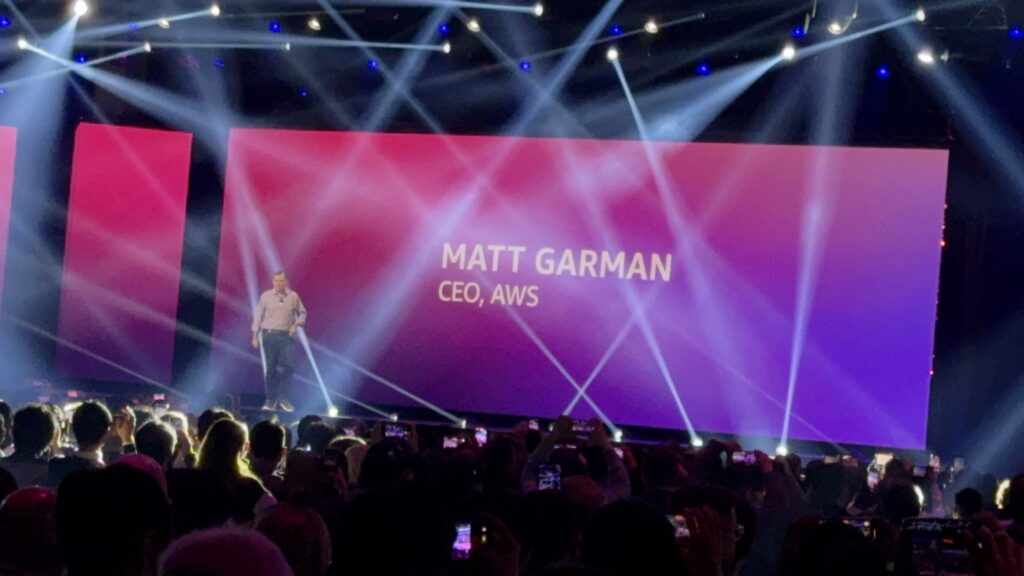
This December, our team had the privilege of attending AWS re:Invent 2025 in Las Vegas — the world’s largest cloud computing conference. Walking through the Venetian’s halls alongside over 60,000 fellow cloud practitioners, the energy was palpable. From packed keynote sessions to hands-on workshops and late-night conversations with AWS engineers and partners, re:Invent 2025 delivered on its promise of being a learning conference unlike any other.
Las Vegas witnessed history as AWS unveiled a transformative vision for cloud computing. With nearly 2 million more watching online, AWS CEO Matt Garman opened the conference with a striking statistic: AWS has grown to a $132 billion business, accelerating 20% year over year. But beyond the numbers lies something far more profound – the emergence of agentic AI as the defining technology shift of our generation.
The agentic revolution: beyond chatbots
„The advent of AI agents has brought us to an inflection point in AI’s trajectory,” declared Matt Garman. „It’s turning from a technical wonder into something that delivers us real value.”
This isn’t hyperbole. We’re witnessing the evolution from AI assistants that merely suggest actions to autonomous agents that execute complex workflows, make decisions, and deliver measurable business outcomes. As Werner Vogels, AWS CTO, emphasized in his final re:Invent keynote: „Will AI take my job? Absolutely not – if you evolve.”
For our customers, this means a fundamental shift in how we approach cloud infrastructure and DevOps. The question is no longer whether to adopt AI, but how to architect systems that enable agentic workflows at scale.
Amazon Bedrock: the comprehensive AI platform
Amazon Bedrock continues to be AWS’s answer to the fundamental question: how do you build production-ready generative AI applications at scale? With over 50 customers now processing more than 1 trillion tokens each through Bedrock, the platform has proven its enterprise readiness.
Model choice and Amazon Nova 2
„We’ve never believed that there was going to be one model to rule them all,” Garman emphasized, „but rather that there would be a ton of great models out there.” This philosophy drives Bedrock’s approach to model selection, which has nearly doubled over the past year.
The headline announcement was Amazon Nova 2, AWS’s next-generation family of foundation models delivering frontier-level intelligence at cost-optimized performance:
Nova 2 Lite: A fast, cost-effective reasoning model ideal for high-volume production workloads. In benchmarks, it matches or exceeds models like Claude Haiku 3.5, GPT-4o Mini, and Gemini Flash 2.0 – at industry-leading price-performance.
Nova 2 Pro: The most intelligent reasoning model for complex workloads, excelling at instruction following and agentic tool use. In Artificial Analysis benchmarks, Nova 2 Pro outperforms GPT-4o, Gemini 1.5 Pro, and Claude 3.5 Sonnet on critical agentic capabilities.
Nova 2 Sonic: Next-generation speech-to-speech model enabling real-time, human-like conversational AI with improved latency and expanded language support.
Nova 2 Ami: The industry’s first reasoning model supporting text, image, video, and audio input with text and image generation output – a unified multimodal model that eliminates the need to stitch together multiple specialized models.
Nova Forge: open training models
Perhaps the most groundbreaking announcement was Amazon Nova Forge, introducing the concept of „open training models.” Unlike traditional fine-tuning, Forge allows customers to blend their proprietary data with Amazon’s curated training datasets during the pre-training phase itself.
„What if you could integrate your data at the right time during the training of a frontier model, and then create a proprietary model that was just for you,” Garman posed. „I think this is actually what customers really want.”
The results speak for themselves. Reddit used Forge to create a content moderation model that finally met their accuracy targets – something fine-tuning existing models couldn’t achieve. By integrating community-specific knowledge during pre-training, they developed integrated representations that naturally combined general language understanding with Reddit’s unique domain expertise.
For enterprises with deep domain knowledge – whether in healthcare, finance, manufacturing, or legal—Nova Forge represents a paradigm shift. Your „Novellas” (custom models created through Forge) deeply understand your business while retaining the reasoning capabilities of frontier models.
Expanded model catalog
Bedrock’s model selection continues to grow with new additions including:
- Mistral Large: 5x more parameters than Mistral Large 2, with doubled context window
- Ministral 3: Three models optimized for edge devices and single-GPU deployments
- Google Gemma Mini, MiniMax M2, and Nvidia Nimmotron
This breadth ensures customers can select the optimal model for each use case—balancing cost, latency, and capability requirements.
Amazon Bedrock Agent Core: the foundation for production agents
Building on Bedrock’s model platform, Amazon Bedrock Agent Core provides the infrastructure to deploy agents securely at enterprise scale. Since its launch just months ago, the Agent Core SDK has been downloaded over 2 million times, signaling unprecedented adoption.
What makes Agent Core revolutionary for our DevOps practice?
1. Serverless runtime with session isolation
Agents run in complete isolation, ensuring sensitive data never leaks between sessions—critical for our enterprise clients in regulated industries.
2. Agent Core memory
Both short and long-term memory capabilities allow agents to learn and improve over time, maintaining context across interactions.
3. Agent Core gateway
Secure connectivity to tools, data sources, and other agents, enabling complex multi-agent orchestration.
4. Agent Core Policy (New!)
Real-time deterministic controls for agent behavior. As Garman explained: „Policy provides you with real-time deterministic controls for how your agents interact with your enterprise tools and your data.” This addresses the critical trust gap that has prevented many enterprises from deploying agents to production.
Policy uses Cedar, an open-source authorization language powered by AWS’s automated reasoning work, to evaluate every agent action in milliseconds before granting access to tools or data.
5. Agent Core Evaluations (New!)
Continuous quality monitoring with 13 pre-built evaluators for correctness, helpfulness, and harmfulness – automating what previously required data scientists and complex pipelines.
6. Episodic Memory (New!)
A new capability within Agent Core’s long-term memory that enables agents to remember and learn from past experiences. Agents can recognize patterns across similar situations and proactively offer solutions – like understanding the difference between solo business travel and family vacation planning.
Infrastructure innovation: the foundation that enables everything
While agentic AI captured headlines, AWS reinforced its commitment to the core attributes that have defined cloud computing for two decades: security, availability, performance, elasticity, cost optimization, and agility.
AWS Trainium: redefining AI infrastructure economics
„Trainium 2 is actually the best system in the world currently for inference,” Garman revealed. This isn’t just marketing – the majority of Amazon Bedrock inference already runs on Trainium, delivering superior price-performance.
Trainium has already reached over 1 million deployed chips—ramping 4x faster than any previous AI chip AWS has deployed. It represents a multi-billion dollar business today and continues to grow rapidly.
The newly announced Trainium 3 represents a quantum leap:
- 4.4x more compute than Trainium 2
- 3.9x memory bandwidth increase
- 5x more AI tokens per megawatt of power
- First 3-nanometer AI chip in the AWS Cloud
- 144 Trainium 3 chips in Ultra servers delivering 362 FP8 petaflops
For infrastructure-conscious organizations, that last metric is transformative. As energy costs and sustainability concerns mount, Trainium 3’s efficiency gains translate directly to operational savings and reduced carbon footprint.
And AWS isn’t stopping there – Trainium 4 is already in development, promising 6x the FP4 compute performance and 4x more memory bandwidth compared to Trainium 3.
AWS AI Factories
For customers requiring dedicated AI infrastructure with stringent compliance and sovereignty requirements, AWS announced AI Factories—enabling deployment of dedicated AWS AI infrastructure in customer data centers. These operate like private AWS regions, providing:
- Exclusive use of leading AWS AI infrastructure (Trainium Ultra servers, Nvidia GPUs)
- Access to SageMaker and Bedrock services
- Customer control over data center space and power capacity
- AWS management of infrastructure operations
Graviton 5: the next generation of ARM-based computing
Dave Brown unveiled Graviton 5, delivering 192 cores in a single package with over 5x the L3 cache of previous generations. The M9G instances powered by Graviton 5 offer up to 25% better performance than M8G.
Early customer results are impressive:
- Airbnb: 25% performance improvement
- Atlassian: 20% lower latency
- SAP: 60% better performance on OLTP queries for SAP HANA
For our containerized workloads and Kubernetes deployments, Graviton 5 represents the optimal balance of performance, cost, and energy efficiency.
Amazon Q: Enterprise AI assistant at scale
Amazon Q has rapidly become the enterprise AI assistant of choice, with hundreds of thousands of users inside Amazon alone. Teams report completing tasks in 1/10th the time using Q’s capabilities:
- Deep research: Investigates complex topics by pulling from internal repositories and external sources, delivering comprehensive research reports with citations
- BI capabilities: Discovers insights across structured and unstructured data sources
- Quick Flows: Create mini personal agents to automate repetitive tasks
One standout example: Amazon’s tax team built a Q agent that consolidates tax data from audits, projects, and regulatory sources, performs deep research into tax code changes, and presents everything in a unified view—all without writing code.
Building agents: Strands Agent SDK and frameworks
For developers building custom agents, AWS open-sourced the Strands Agent SDK – a model-driven approach that eliminates thousands of lines of boilerplate orchestration code. Since its preview in May, Strands has been downloaded over 5 million times.
New capabilities announced this week:
- TypeScript support: Extending Strands to one of the world’s most popular programming languages
- Edge device support: Enabling autonomous AI agents in automotive, gaming, and robotics at the edge
Strands works with any model (Bedrock, OpenAI, Gemini) and any framework (Crew AI, LlamaIndex, LangChain), giving developers complete flexibility while leveraging Agent Core’s production-ready infrastructure.
The DevOps transformation: three frontier agents
Perhaps the most exciting announcements for our DevOps practice were the three Frontier agents that will fundamentally change how we build, secure, and operate software:
1. Kiro autonomous agent
Transforms development velocity by autonomously tackling features, triaging bugs, and improving code coverage – all in the background. One Amazon team reduced a project from 30 developers over 18 months to just 6 people in 76 days using agentic development.
2. AWS security agent
Embeds security expertise upstream, proactively reviewing design documents, scanning code for vulnerabilities, and conducting on-demand penetration testing. As Garman noted: „Security agent can catch these issues early… from your design documents before you write a line of code.”
3. AWS DevOps agent
Resolves and prevents incidents by correlating telemetry across multi-cloud and hybrid environments. It diagnoses issues, suggests fixes, and recommends preventive guardrails—all before your on-call engineer even logs in.
Compute innovations: expanding choice and performance
AWS continues to deliver the broadest selection of compute instances, ensuring customers always have the optimal instance for their workloads:
New EC2 instance families
X Family (Large Memory): Next-generation instances powered by custom Intel Xeon 6 processors, providing up to 50% more memory. AMD EPYC-based instances now offer 3TB of memory—ideal for SAP HANA, SQL Server, and EDA workloads.
C8A Instances: Based on latest AMD EPYC processors, delivering 30% higher performance for CPU-intensive applications like batch processing and gaming.
C8INE Instances: Powered by custom Intel Xeon 6 processors with Nitro V6 cards, delivering 2.5x higher packet performance per vCPU—perfect for security and network applications.
M8AZN Instances: Featuring the fastest CPU clock frequency available in the cloud, optimized for multiplayer gaming, high-frequency trading, and real-time analytics.
Mac Instances: New EC2 M3 Ultra Mac and M4 Max Mac instances powered by latest Apple hardware, enabling developers to build, test, and sign Apple apps on AWS with cutting-edge performance.
GPU acceleration
P6E GB300: Powered by Nvidia’s latest GB300 NVL72 systems, continuing AWS’s leadership in providing best-in-class compute for the most demanding AI workloads. AWS was the first to offer Nvidia GPUs in the cloud and maintains the industry’s best GPU reliability through operational excellence.
Database and storage: expanding the possible
AWS announced significant expansions to core services:
Storage innovations
- S3 maximum object size increased to 50 terabytes (10x increase)
- S3 batch operations now 10x faster
- S3 Intelligent-Tiering for S3 Tables: Save up to 80% on storage costs for Iceberg table data automatically
- S3 Tables cross-region replication: Automatically replicate S3 tables across AWS regions and accounts for consistent query performance
- S3 Vectors (GA): Store trillions of vector embeddings with 90% cost reduction
- S3 Access Points for FSX for NetApp ONTAP: Access ONTAP file data seamlessly as if it were in S3
- GPU acceleration for vector indices in Amazon OpenSearch: Index data 10x faster at 1/4 the cost
Database enhancements
- RDS for SQL Server and Oracle: Storage capacity increased from 64TB to 256TB with 4x improvement in IOPS and IO bandwidth
- RDS SQL Server VCPU control: Specify the number of VCPUs enabled to reduce per-CPU licensing costs
- RDS SQL Server Developer Edition: Build and test applications with no licensing fees
- Database Savings Plans: Up to 35% savings across all database services
- EMR Serverless storage: No longer need to provision local storage for EMR serverless clusters
For data-intensive applications and AI workloads, these improvements remove previous constraints and enable new architectural patterns.
Serverless evolution: Lambda innovations
Lambda managed instances
Peter DeSantis introduced Lambda Managed Instances, elegantly bridging serverless simplicity with EC2 performance control. Your Lambda functions run on EC2 instances in your account, but AWS manages provisioning, patching, availability, and scaling.
„Serverless was never about the absence of servers,” DeSantis explained. „It was always about the absence of server management.”
This opens Lambda to workloads that previously lived outside its scope: video processing, ML pre-processing, and high-throughput analytics—all with zero operational burden.
Lambda Durable Functions
For workflows requiring long wait times – like agents working in the background for hours or days – Lambda Durable Functions makes it easy to manage state and build long-running workloads with built-in error handling and automatic recovery. No more complex orchestration code for asynchronous workflows.
Security and observability enhancements
AWS continues to strengthen security and operational capabilities:
GuardDuty extended threat detection
GuardDuty for ECS: Extended threat detection now available for Amazon ECS, complementing existing EKS support. Monitor and protect all your containers and EC2 instances with AWS’s most advanced threat detection—at no additional cost for existing GuardDuty customers.
Security Hub enhancements (GA)
The enhanced Security Hub now includes:
- Near real-time risk analytics
- Trends dashboard for security posture tracking
- Streamlined pricing model
- Aggregated security data from AWS and third-party sources
CloudWatch unified data store
New unified data store in CloudWatch for all operational, security, and compliance data. Automates log collection from AWS services and third parties (Okta, CrowdStrike, etc.), storing data in S3 or S3 Tables for faster issue resolution and deeper insights.
AWS Transform Custom: modernization at scale
Building on the success of AWS Transform (which has already analyzed over a billion lines of mainframe code), AWS announced Transform Custom – enabling custom code transformation agents for any language, framework, or API.
The new composability feature allows partners to integrate their own tools and knowledge bases, creating tailored modernization workflows. Western Union leveraged this with Accenture to analyze 2.4 million lines of mainframe code, achieving a 2x speed increase.
Customers have already used Transform to save over 800,000 hours of manual effort and 380 developer years of work – transforming legacy systems from VMware, mainframes, and Windows/.NET to modern cloud-native architectures.
Spec-driven development with Kiro
This philosophy manifests in Kiro, AWS’s agentic development environment. Kiro has popularized spec-driven development, where developers create detailed specifications that agents transform into working code. Since preview launch just months ago, hundreds of thousands of developers have adopted Kiro.
The impact is staggering: one Amazon team completed an 18-month, 30-developer project with just 6 people in 76 days using Kiro. Amazon has standardized on Kiro as its official AI development environment.
Special offer: AWS is giving away a year of Kiro (up to 100 seats) for qualified startups who apply within the next month.
What this means for our customers
The announcements at re:Invent 2025 validate the architectural principles we’ve championed:
Agentic AI at scale: From Bedrock’s Nova 2 models and Forge to Agent Core’s policy engine and episodic memory, AWS provides the complete toolkit for building production-ready agents.
Security-first design: Agent Core’s policy engine, enhanced GuardDuty, and Security Hub provide the guardrails enterprises need to deploy AI confidently.
Infrastructure optimization: Graviton 5 and Trainium 3 deliver the price-performance improvements that make cloud economics work at scale, with 5x better energy efficiency.
Developer productivity: Kiro’s spec-driven development, the three Frontier Agents, and Strands SDK are transforming how we build software – enabling 10x productivity gains.
Data and storage innovation: S3’s expanded capabilities (50TB objects, Vectors, Tables), enhanced databases, and unified CloudWatch logging enable the data strategies that power intelligent applications.
Modernization velocity: Transform Custom with composability accelerates legacy system migrations, reducing technical debt and unlocking agility.
Compute breadth: From new Mac instances to the fastest CPU frequencies, largest memory configurations, and best GPU reliability, AWS continues to expand choice.
Looking forward
As Matt Garman stated: „Getting to a future of billions of agents, where every organization is getting real-world value and results from AI is gonna require us to push the limits of what’s possible with the infrastructure.”
At Tehma Cloud, we’re not just observers of this transformation – we’re active participants. Our AWS partnership and deep expertise in cloud-native architectures position us to help customers navigate this agentic revolution.
The future isn’t about AI replacing developers. It’s about developers wielding AI as a force multiplier, building systems that were previously impossible, and delivering value at unprecedented speed.
As Werner Vogels reminded us: „The work is yours, not that of the tools. It is your work that matters.”
Interested in exploring how agentic AI and AWS’s latest innovations can transform your infrastructure? Contact us to discuss your cloud-native journey.
About us: https://tehmacloud.com/about-us/